
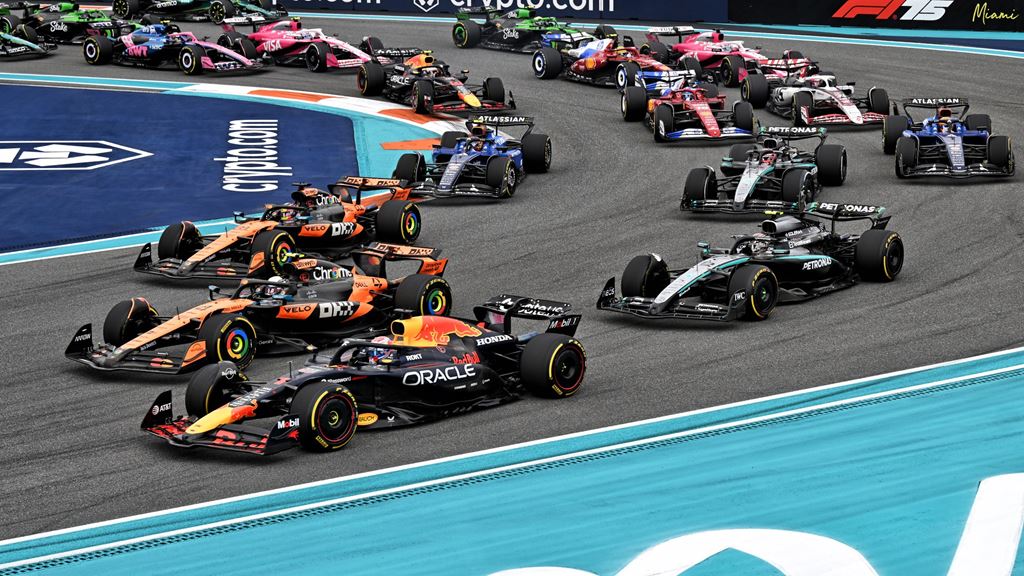
The Miami Grand Prix, held on May 12, 2025, became a revealing battleground for all ten Formula 1 teams, particularly spotlighting the competitive dynamics between Red Bull, Ferrari, and McLaren. The high temperatures and slippery surface of the Miami International Autodrome proved to be formidable challenges, resulting in Max Verstappen finishing fourth, trailing the two McLaren drivers and underscoring Red Bull's current limitations.
"Max Verstappen remains the closest challenger to the two McLaren drivers," remarked an analyst on the team dynamics. Despite his skill and determination, Verstappen found himself at a disadvantage as the RB21 car struggled with race pace.
This season, McLaren has seemingly found the ideal balance in their MCL39, which has adapted seamlessly to the Miami circuit's demands. The car’s capacity to withstand high thermal stress in slower corners was evident.
"The McLaren MCL39 was almost perfectly adapted to the layout of Miami International Autodrome," noted a team representative. "It managed to exploit aggressive driving lines on corner entry without triggering skidding or loss of traction."
While Verstappen's frustrations mount, McLaren has been in unparalleled form, securing five victories in the first six races of the season. The duo of drivers, Oscar Piastri and Lando Norris, have been impressive, showcasing their ability to maintain tire temperature consistency, a feat other teams, including Ferrari and Red Bull, have struggled to achieve.
“McLaren manages to get both front and rear tyres working in synergy,” said a leading motorsport analyst. “This limits tyre degradation and optimizes traction on exit, which is essential in these demanding conditions.”
The team’s strategic innovations, including discussions around new aerodynamic features like a rear diffuser, underscore their proactive approach. However, it's worth noting that the diffuser was not utilized in Miami, indicating that it may need further validation for its effectiveness.
As McLaren sets the pace, Red Bull has embarked on a journey of continuous improvement. Investigations into advanced tire heat management are underway, with engineers exploring aerodynamic solutions that integrate convective heat transfer methods — a natural phenomenon that could enhance tire cooling efficiency.
"We are starting to see a shift in how Red Bull approaches tire management; convective heat transfer seems to be a key interest area for us right now," explained a Red Bull team engineer, reflecting the team's commitment to closing the performance gap. This method, which involves circulating cooler air to mitigate heat build-up, represents a shift in strategy for the team.
In a parallel effort, Red Bull also introduced subtle design changes to Verstappen’s car for the Miami event, specifically to the floor of the RB21. This redesign aimed to enhance stability, particularly through the Venturi tunnels, where consistent downforce is crucial.
“Verstappen’s new floor appears to enhance how the car reacts to rolling and pitching, possibly offering greater stability during races,” said a team analyst. This move hints at a more comprehensive upgrade package planned for subsequent races, including Imola, known for its demanding bumps and curves.
While Ferrari faced difficulties in Miami, the team is working hard to regain competitiveness. Following a disappointing showing, they recognize the necessity of evolving their strategy to keep pace with rivals like McLaren and Red Bull.
As the 2025 season approaches its midpoint, the challenges for Ferrari and Red Bull underscore a thrilling narrative of competition in Formula 1. With McLaren leading the way, both competitors are under pressure to innovate continually and reclaim their positions on the podium. The upcoming races will be critical for determining how well these teams can adapt and whether they can level the playing field against a strong McLaren force.